IICRC Certified | Licensed & Insured | Direct Insurance Billing
24/7 Emergency Response (425) 433-9550
Home › Crawl Space Services

Crawl Space Water Damage Services Everett WA

Your crawl space and your living space share the same air. Whatever is happening under your floor — standing water, mold, wet insulation, wood rot — rises into your home through gaps around pipes, wiring, and HVAC returns. A wet crawl space is not an isolated problem. It is a whole-house air quality problem.

Call (425) 433-9550 Free Inspection
Everett Crawl Space Specialist

24/7 Crawl Space Emergency Response in Everett

Standing water in a crawl space can accumulate unnoticed for weeks. By the time it shows — through a musty smell, bouncy floors, or a visual check — the moisture has already been working on your wood framing, insulation, and vapor barrier for longer than the standing water alone suggests.

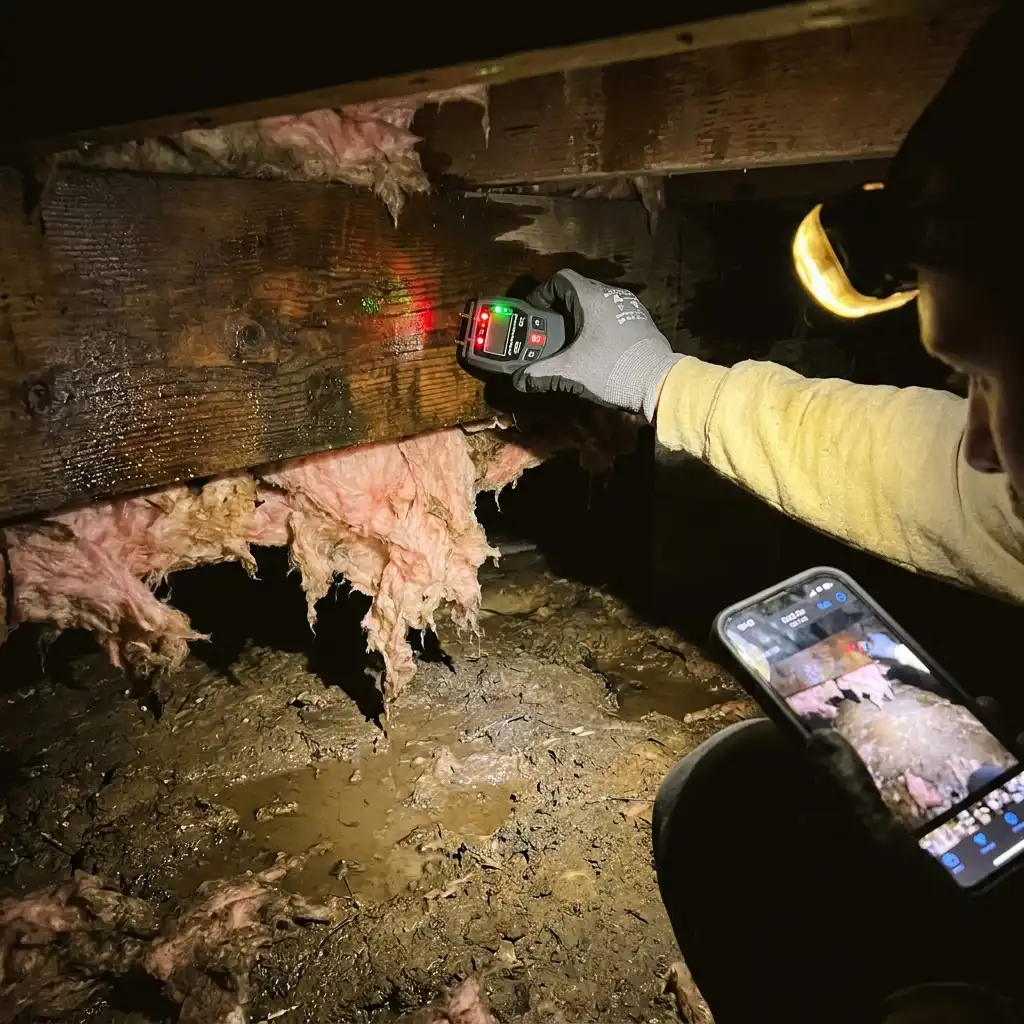
We respond to crawl space calls around the clock. Here is what the first visit covers:

  • Visual inspection of the full crawl space with moisture meters and photos
  • Standing water extraction with equipment sized for confined-space access
  • Assessment of insulation condition, vapor barrier integrity, and wood moisture levels
  • Mold identification on floor joists, vapor barrier, and any wood surfaces
  • Scope of work and cost estimate before any work begins
Crawl space water damage inspection Everett WA
IICRC Certified
60-Min Response
Insurance Docs Included
Standing water under your home?

60-minute response, 24 hours a day — confined-space equipment on the truck.

(425) 433-9550
Root Causes

Why Everett Crawl Spaces Get Wet

Crawl spaces are more exposed to moisture than any other part of a home. Four factors specific to Everett make this worse.

Foundation Vents and Pacific Air

Older Everett homes were built with open foundation vents intended to ventilate the crawl space. In the Pacific Northwest, this works against you. Everett air is consistently humid, especially October through April. When warm, humid outside air meets the cool crawl space surfaces, it condenses — depositing moisture on floor joists, insulation, and the vapor barrier. This is the primary cause of crawl space moisture in Everett homes that have no obvious water intrusion or plumbing problem.

Groundwater in Low-Lying Neighborhoods

In Riverside, Bayside, Lowell, and neighborhoods adjacent to the Snohomish River, the groundwater table rises significantly during the October-through-March wet season. When the water table is high, moisture migrates upward through the soil and enters the crawl space directly. This is distinct from a surface water or plumbing source — it rises from below. Homes on low-lying ground near the river often have seasonally wet crawl spaces regardless of surface conditions.

Failed or Inadequate Vapor Barriers

A vapor barrier is the sheeting that covers the soil floor of a crawl space to block ground moisture from evaporating into the space above. Many pre-1970 Everett homes were built with no vapor barrier, with old tar paper that has long since degraded, or with thin poly sheeting that has torn, shifted, or is poorly lapped at the seams. A damaged vapor barrier lets ground moisture enter continuously and is one of the most common root causes of persistent crawl space dampness in older Everett homes.

Plumbing Leaks Above the Crawl Space

Supply lines, drain pipes, and water heater connections that run through the crawl space can leak slowly for months before any visible sign appears upstairs. The water drips into the crawl space, soaks the insulation below the floor, and creates a mold environment in the dark below your feet. This source is covered by homeowners insurance as a sudden and accidental event if it can be tied to a specific pipe failure.

Crawl space moisture left untreated becomes mold in 48 hours.

The longer standing water sits, the more insulation, joists, and subfloor absorb. Call before the scope grows.

Call Now
Air Quality

The Stack Effect: Why Your Crawl Space Air Is Your Indoor Air

A house operates like a chimney. Warm air rises from the bottom and exits at the top. To replace the rising air, the house draws air in from the lowest point — usually the crawl space. This is the stack effect, and it is the reason a wet crawl space is not just a structural problem.

When your crawl space has elevated moisture, mold growth, or standing water, the air that rises through your floor carries those conditions with it. Mold spores, musty odors, and elevated humidity travel up through:

  • Gaps around pipes and wiring where they penetrate the subfloor
  • HVAC return air ducts in homes where ductwork runs through the crawl space
  • Unsealed floor gaps around tub surrounds, toilet flanges, and utility penetrations

This is why homeowners with crawl space mold often report musty odors in rooms far above the crawl space, unexplained allergy symptoms, or elevated indoor humidity even in dry weather. We assess the stack effect pathways as part of every crawl space inspection.

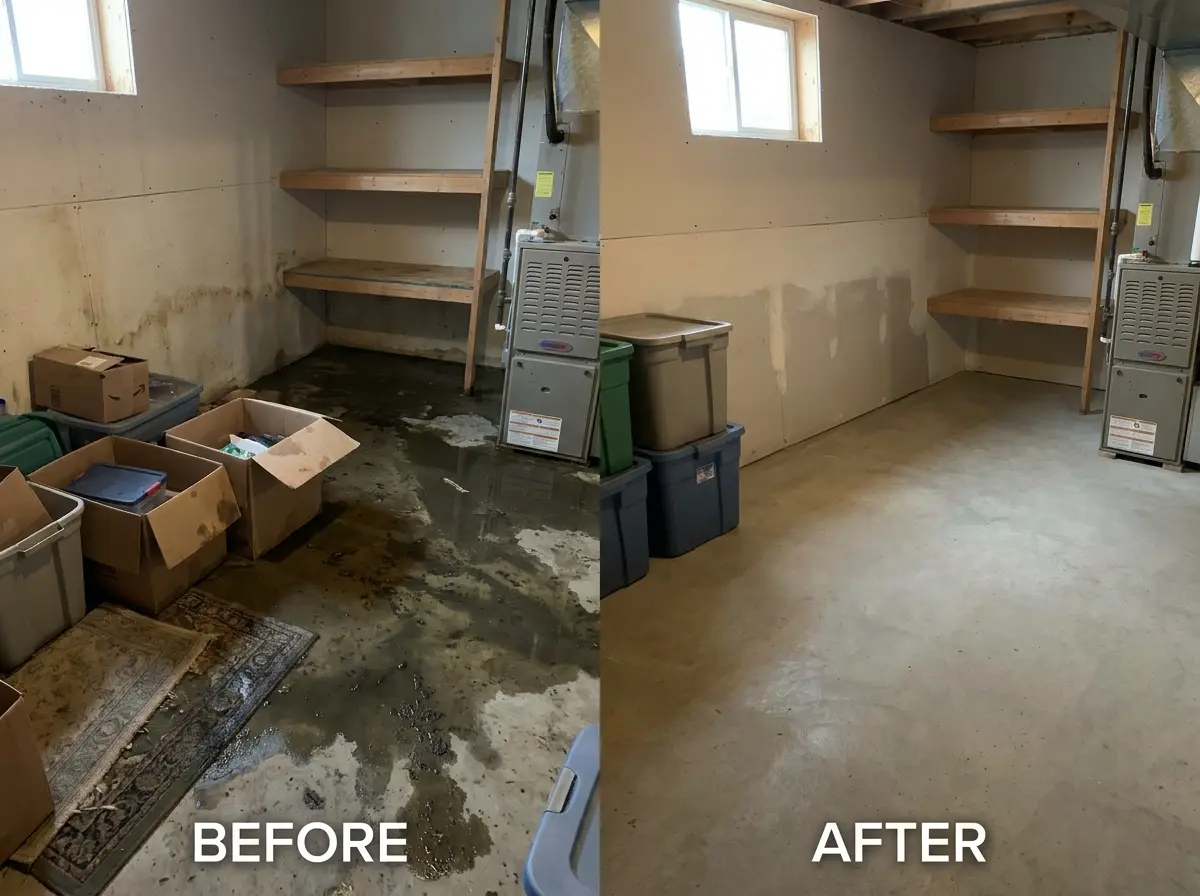
Before and after crawl space water damage cleanup Everett WA
How We Work

Our Crawl Space Restoration Process in Everett

Every job follows the same sequence, adjusted for the conditions we find.

1

Inspection and Moisture Mapping

We enter with moisture meters, a thermal camera, and adequate lighting. We map moisture levels in the soil, vapor barrier, insulation, and wood framing. Photos document every affected area before any work begins. This forms your insurance record.

2

Standing Water Extraction

If water is present, we extract it with equipment suited to confined-space access. Standard truck-mounted extractors cannot be used in confined crawl access — we use submersible pumps and portable extractors suited to the space dimensions.

3

Wet Insulation Removal

All insulation that has absorbed moisture is removed. This is not optional — wet fiberglass cannot be dried in place, and leaving it prolongs the moisture exposure to the framing above. The removed insulation is bagged and disposed of properly. All removed material is recorded for your insurance claim.

4

Structural Drying

After extraction and insulation removal, industrial drying equipment runs until the floor joist moisture readings meet the ANSI/IICRC dry standard. Crawl spaces dry more slowly than above-grade spaces because of confined airflow and proximity to the ground. We typically run equipment for 5 to 10 days and check readings daily.

5

Mold Treatment

Any mold on joist faces, subfloor undersides, or the barrier sheeting is treated with EPA-registered antimicrobial products. For significant mold growth, we establish containment and follow the IICRC S520 mold remediation standard. A clearance assessment confirms the space meets safe levels before we close it back up.

6

Vapor Barrier Repair or Replacement

Once the structure is dry and treated, we install or repair the sheeting. When properly installed, it covers the full soil floor with sealed, overlapping seams and runs up the foundation walls. This is the primary long-term defense against ground moisture. We can discuss encapsulation options for homeowners who want a fully sealed space rather than a vented one.

Free Inspection

Ready to fix your crawl space for good?

Call Water Restoration Pros for a free inspection and assessment. We cover all of Snohomish County.

Long-Term Risk

What a Wet Crawl Space Does to Your Home Over Time

Insulation Falls and Becomes a Mold Substrate

Fiberglass batt insulation installed between floor joists absorbs moisture, becomes heavy, and eventually falls from the staples holding it. Once it falls to the crawl space floor, it lies in contact with the damp ground and becomes a mold substrate. Fallen insulation provides no thermal protection and creates an active mold environment below your living area. Wet insulation in this situation cannot be dried in place and must be removed and replaced.

Floor Joists Absorb Moisture and Begin to Rot

Wood floor joists are the structural members holding up your floor. Sustained moisture exposure causes them to absorb water, lose strength, and eventually develop rot and fungal decay. Early signs include floors that feel soft or bouncy underfoot, doors that stick or no longer align, and visible darkening on the joist faces. Once rot begins, affected sections must be sistered or replaced. This is the most expensive crawl space outcome and the most preventable.

Mold Establishes in the Dark

The space is dark, damp, poorly ventilated, and rarely inspected. Mold grows on floor joist faces, the underside of the subfloor, and on any organic debris. Because the area is unoccupied, growth is not noticed until the odor rises into the living area or visible damage appears above. Mold remediation in a crawl space requires the same containment and air filtration protocol as above-grade mold work, plus the confined space access considerations.

Insurance Coverage

Does Insurance Cover Crawl Space Water Damage in Everett?

The cause determines the coverage. A plumbing leak that drips into the crawl space is typically covered as a sudden and accidental event. Storm-driven water that enters through a compromised foundation vent may be covered depending on the circumstances.

Groundwater seepage from a high water table and general dampness from condensation are excluded as gradual or maintenance issues. We document the water source, timeline, and extent of damage to support your claim.

  • Covered: Pipe or plumbing failure above the crawl space — sudden and accidental
  • May be covered: Storm-driven water through compromised foundation vents
  • Not covered: Groundwater seepage, condensation, gradual dampness
  • We document the water source and timeline to support your adjuster's classification

Crawl Space Restoration Cost in Everett, WA

Service Typical Cost What Drives It Higher
Water extraction only $800 – $2,500 Crawl space size, water volume
Extraction + insulation removal $2,000 – $6,000 Insulation coverage, access difficulty
Full restoration + mold treatment $4,000 – $12,000 Mold extent, drying days, joist condition
Vapor barrier installation $1,500 – $4,000 Square footage, foundation wall coverage
Full encapsulation $5,000 – $15,000 Full seal, conditioning, drainage systems

What pushes the cost up: crawl space square footage, how long moisture was present before discovery, whether floor joist rot requires structural repair, and the extent of mold growth.

Pipe leak into your crawl space? That is likely a covered claim.

We document everything and bill your insurer directly. Free assessment.

Call for Free Assessment
Service Area

Crawl Space Services Across Everett and Snohomish County

We serve properties in all Everett zip codes — 98201, 98203, and 98208 — including the low-lying neighborhoods near the Snohomish River where groundwater table issues are most common.

Everett Marysville Mukilteo Lake Stevens Mill Creek Lynnwood Snohomish Bothell Edmonds Riverside Bayside Lowell Port Gardner Silver Lake
Call Now — Free Crawl Space Inspection
Available 24 Hours — 7 Days a Week
Common Questions

Frequently Asked Questions About Crawl Space Services in Everett

Common signs: a musty smell in rooms above the crawl space, floors that feel soft or springy underfoot, unexplained humidity in the living area, visible mold or dark staining on floor joists during an inspection, and insulation that has fallen from between the joists. Many of these problems are discovered during a home sale inspection rather than before.

For very minor surface dampness, a homeowner can improve ventilation or add a dehumidifier. Any standing water, fallen insulation, visible mold on joists, or high moisture in the wood framing requires professional equipment. Leaving wet wood to dry slowly without measuring the actual moisture content risks mold and structural damage that develops below the threshold of visible detection.

If a pipe or plumbing failure above the crawl space caused the water, yes — it is covered as a sudden and accidental event. Groundwater seepage, condensation from inadequate vapor barriers, and gradual moisture accumulation are excluded. We document the source and timeline to support a claim for covered events.

A vapor barrier is a poly sheeting layer covering the floor to block ground moisture. Encapsulation is a more complete system: thicker, sealed liner on the floor and walls, plus conditioned air rather than passive vents. Encapsulation is more effective in humid climates like Everett and eliminates the foundation vent condensation problem. We can install both depending on your goals and budget.

Structural drying after water extraction takes 5 to 10 days in a crawl space. Full restoration including insulation removal, mold treatment, drying, and vapor barrier installation typically takes 1 to 2 weeks. Encapsulation adds additional days. We provide a specific timeline after the initial inspection when we know the scope.

Crawl space problems in Everett? Call Water Restoration Pros now.

Free inspection, 60-minute response — confined-space trained crews.

(425) 433-9550

Water Emergency in Everett?

Our IICRC-certified crew is ready 24/7. We respond in 60 minutes — nights, weekends, and holidays.

(425) 433-9550
IICRC Certified 60-Min Response Direct Insurance Billing Licensed & Bonded
24/7 Emergency (425) 433-9550